
UNDERSTAND YOUR SKIN
Warts
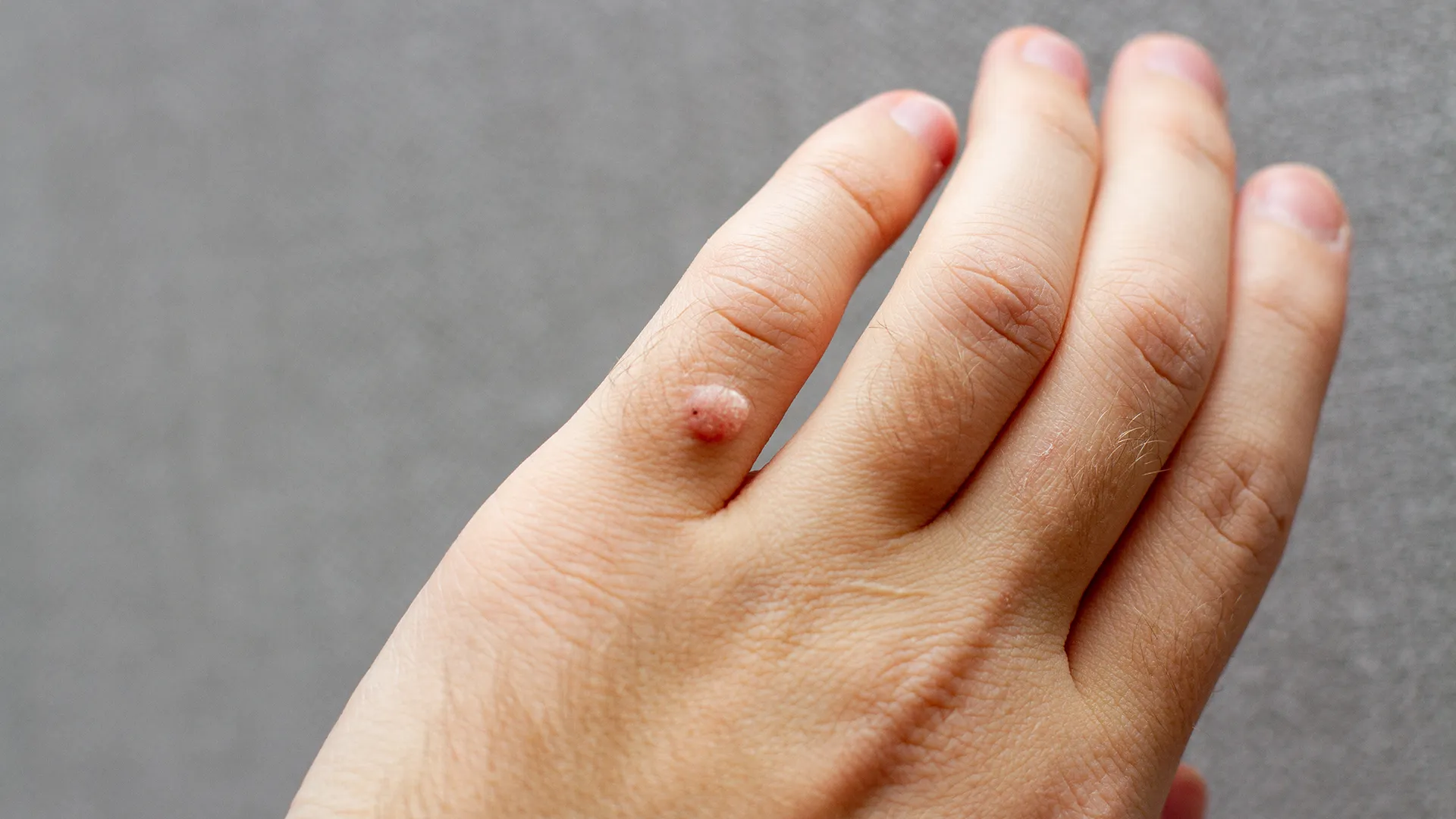
What are warts?
Warts are among the most common benign skin growths. They can occur in both children and adults and affect various parts of the body. Depending on their location and type, they can be almost unnoticeable or cause discomfort, pain and easy bleeding.
The cause of warts is infection with the human papillomavirus (HPV). There are many types of HPV, and different viral types are associated with different varieties of warts. They are transmitted through contact with infected skin or via objects and surfaces, and the likelihood of infection increases in the presence of minor breaches in the skin barrier.
Although in most cases warts do not pose a serious health problem, they can be persistent and last for a long time. Furthermore, a wart can spread to other parts of the body or be passed on to another person. Therefore, correct identification and appropriate treatment are important.
Main signs and symptoms
Depending on the type, a wart may be rough and raised, flat, or grow inwards into the skin. The colour also varies – from flesh-coloured and greyish to darker shades.
Warts are contagious. Transmission can occur through direct skin-to-skin contact or indirectly via shared objects and damp surfaces. Self-infection is also possible – for example, when scratching, shaving or through other mechanical trauma, the virus can be transferred to another area.
Infection does not always result in a visible wart. The body’s immune system may suppress the virus, and the growth may disappear spontaneously.
Types and patterns
There are several main types of warts, which differ in appearance and location.
Common warts – these most commonly appear on the fingers, hands, around the nails and other areas. They are usually hard, rough and raised. Some may have small dark spots, which are thrombosed tiny blood vessels.
Plantar warts – these develop on the soles of the feet. Due to the pressure exerted whilst walking, they often grow inwards and can be painful. They are sometimes confused with calluses or corns.
Flat warts – smaller in size and with a smooth or slightly rough surface. They can appear on the face, hands and other parts of the body and are common in children and young people.
Filiform warts – these are thin, elongated growths that often develop on the face, around the mouth, nose or eyes.
Periungual warts – these appear around or under the nails and can be troublesome, particularly when they disrupt the structure of the nail plate.
Different types do not always look entirely typical. Therefore, a growth that resembles a wart should not automatically be assumed to be one without an examination, especially if it looks unusual.
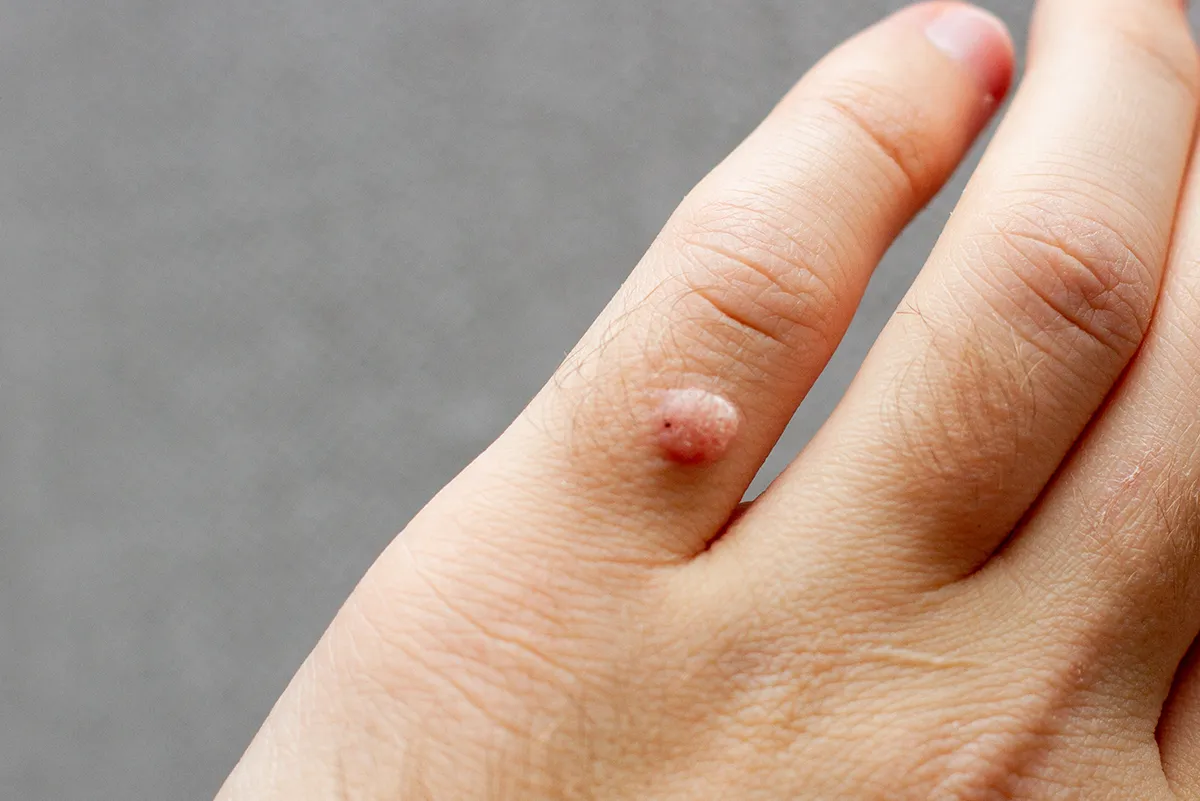
Why does it develop?
Warts are localised, benign skin growths caused by infection with certain types of human papillomavirus. The virus infects the cells of the epidermis and causes accelerated growth of skin tissue.
Causes and risk factors
The main cause is the human papillomavirus (HPV). To reach the deeper layers of the epidermis, the virus usually takes advantage of small breaches in the skin barrier.
The risk of developing warts may be increased by:
- frequent microtrauma and skin abrasions;
- biting one’s nails or the cuticles around them;
- direct contact with a wart;
- sharing personal items;
- visiting damp public places such as swimming pools and changing rooms;
- a weakened immune system;
- the presence of pre-existing warts.
When the skin is damp and softened, the virus penetrates more easily through microscopic breaks in the epidermis. This is one of the reasons why warts spread relatively easily in environments where people walk barefoot.
It is important to note that a person can become infected with HPV without developing warts. The manifestation of the infection depends on the type of virus and the interaction between the virus and the immune system.
Is it a medical condition?
Warts are a viral skin infection, but in most cases they are benign. They are not linked to poor hygiene, and their appearance does not mean that a person is not looking after their skin properly.
In healthy people, many warts disappear spontaneously over a period of months or years, as the immune system gradually brings the viral infection under control.
However, not all HPV infections are the same. The types of HPV that cause common, flat and plantar warts are different from certain other types of HPV associated with genital infections and specific types of cancer.
Therefore, not all HPV infections should be regarded as the same condition.
Everyday care
Daily care is essential for limiting the spread of the virus and protecting the surrounding skin.
It is recommended that you:
- do not cut or trim the wart yourself;
- do not scratch or pick at it;
- do not share towels, nail clippers, nail files or other personal items;
- wash your hands after touching the affected area;
- do not use any instruments used on the wart on healthy skin;
- keep your feet dry if you have plantar warts.
If the wart is in a place that rubs against shoes or clothing, a suitable protective dressing may be used. This limits mechanical irritation and the accidental spread of the virus.
When treating warts with products containing salicylic acid, the instructions for use must be strictly followed. These preparations are not suitable for every area or every person.
Popular home remedies: benefits and limitations
The best-studied method for the home treatment of certain common and plantar warts is salicylic acid, used in the form of suitable over-the-counter preparations. It must be applied regularly and strictly in accordance with the instructions.
Before using some products, it is recommended to soak the affected area in warm water and carefully remove the softened dead skin without causing bleeding. Scissors, razors or other sharp instruments must not be used to cut away the wart.
Popular home remedies such as vinegar, garlic or other strongly irritating substances have not been reliably proven to be a safe and effective treatment. They may cause chemical or inflammatory damage to the skin.
For people with diabetes, poor circulation, reduced sensation in the feet or a weakened immune system, self-treatment of warts is not advisable without consulting a healthcare professional.
When should you see a doctor?
A dermatological examination is recommended if you are unsure whether a growth is actually a wart. Some other skin lesions may look similar and require different treatment.
See a specialist if:
- the growth bleeds for no apparent reason;
- it changes rapidly in size, colour or shape;
- it causes severe or persistent pain;
- multiple new lesions appear within a short period of time;
- it is located on the face or near the eyes;
- it is under a fingernail or alters the structure of the nail;
- it does not respond to appropriate treatment;
- you have a weakened immune system;
- you are unsure whether it is a wart, a callus or another skin growth.
Particular care is needed with growths on the soles of the feet. Plantar warts can be mistaken for calluses, and the approach to the two conditions is different.
Modern treatment options
Treatment is chosen according to the type, size, number and location of the warts. Not every wart requires immediate treatment, particularly if it is small, painless and likely to disappear on its own.
One of the most commonly used methods is cryotherapy, in which the wart is treated with a very low temperature, usually using liquid nitrogen. The freezing damages the affected tissue and, following subsequent healing, the growth gradually shrinks. Sometimes several sessions are required.
Another approach involves the use of keratolytic agents, most commonly salicylic acid, which gradually breaks down the thickened keratinised tissue. The treatment requires consistency and correct application.
In the case of persistent or multiple warts, the dermatologist may discuss other methods, including laser treatment, electrosurgical techniques, curettage or certain topical immunotherapies. The choice depends on the specific clinical situation.
It is important to bear in mind that the removal of the visible wart does not necessarily mean the immediate elimination of HPV from the skin. Therefore, recurrences are possible.
Read the clinical guidance on this concern. Treatment suitability, risks and availability should be discussed during consultation. Find your Skin Line clinic for assessment and personalised advice.